Breeding Farm Setup
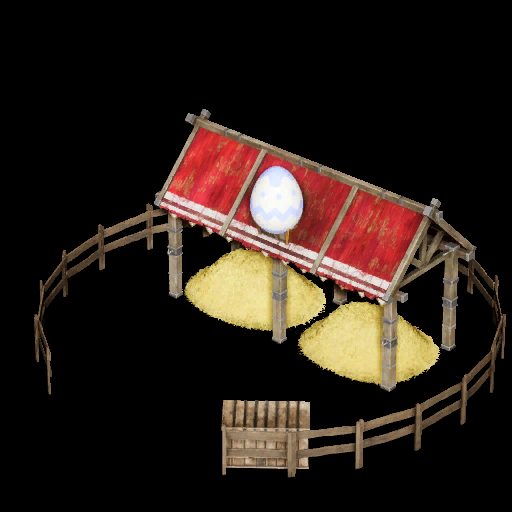
- Build a Breeding Farm (Tech 19) — a large pen, place it flat with room around it.
- Assign a male and a female of your chosen species (or the right combination — see below).
- Feed them cake: make cake at the cooking pot (Flour + Red Berries + Milk + Egg + Honey). No cake = no eggs.
- Wait for a large egg to appear, then pick it up.
- Incubate in an Egg Incubator (Tech 7) and wait for the hatch timer.
Combination Logic & Common Recipes
Breeding uses a hidden "power value" system: each pal has a numeric breeding power, and the offspring is determined by the two parents' values (roughly the average, then looked up). In practice, most players use known recipes from the community breeding calculators rather than guessing. Common targets:
| Target Pal | Easy combination | Why it matters |
|---|---|---|
| Anubis | Eikthyrdeer × Grizzbolt / various ground combos | Best early handiwork + mining pal |
| Frostallion Noct | Frostallion × Helzephyr | Dark legendary mount |
| Jormuntide | Helzephyr × Grizzbolt / water combos | Top watering worker |
| Jetragon | Specific dragon combos (verify on calculator) | Fastest flyer |
| Paladius / Necromus | Specific legendary combos | Endgame fighters |
⚠️ Combination tables change with patches — always re-check a breeding calculator after an update. Exact parent pairs above are directional, not guaranteed.
Passive Skill (Trait) Inheritance
- Parents pass down passives: each parent contributes traits; offspring inherit a random mix.
- Best-in-slot passives (combat): Ferocious (+atk), Musclehead (+atk), Lucky (+atk/luck), Legend (legendary-only, +atk/def/speed).
- Work passives: Serious, Work Slave, Lucky, Artisan — stack to make super workers.
- How to build a god-roll: breed two parents each holding 2 of the 4 desired passives → hatch → keep the offspring that inherited all 4 → breed it with a pal carrying the same 4 (or repeat until a 4/4 baby appears).
💡 Patience tip: 4/4 inheritance is rare (roughly 1 in several dozen eggs). Use a breeding calculator's "target passive" mode to speed it up.
Legendary Pal Cultivation
- Capture or breed the base species (Frostallion, Jetragon, Paladius, Necromus).
- Breed the legendary with a compatible partner to make a "breedable line" that keeps the legendary's high power value.
- Use the calculator to find a pair that yields your target with the Legend passive guaranteed to appear.
- Stack the other 3 passives via the inheritance loop above.
⚠️ Legendary passives can't be transferred from another species — they only appear on legend-born offspring.
Eggs & Incubation
| Egg size | Hatch time | Tip |
|---|---|---|
| Common | ~5 min | Good early-game filler |
| Large | ~30 min | Standard breeding output |
| Huge (dragon) | 2-4 hours | Legendary lines — incubate overnight |
Egg Incubator placement affects temperature — fire regions speed up flame eggs; snowy regions speed up ice eggs. Keep 2-3 incubators running for parallel breeding.
FAQ
Egg incubation and the pacing trick
Incubation time scales with egg type and temperature fit: matching the incubator's climate to the egg's element shaves meaningful hours, and the incubation queue keeps the breeding loop moving while you play. The mistake to avoid is hoarding eggs for a batch hatch — stagger them so passives get evaluated and the farm never stalls.
The four-generation legendary plan
Legendary cultivation is a breeding project, not a capture hunt: pick the target species, breed parents with the four passives you want, and use the farm's egg output as the reroll mechanism — each egg is a fresh draw of the parents' trait pool. The plan usually costs more cakes than silver, which is why the farm setup section spends so long on the cake economy.
The combination logic in one minute
Breeding runs on species-combination recipes: two parent species produce a child species according to the game's combination table, not genetics — the child is usually a fixed result of the parent pair. The table above lists the common recipes; the strategic layer is that passive skills inherit from parents, so the real product of any pairing is the child's traits, not its species.